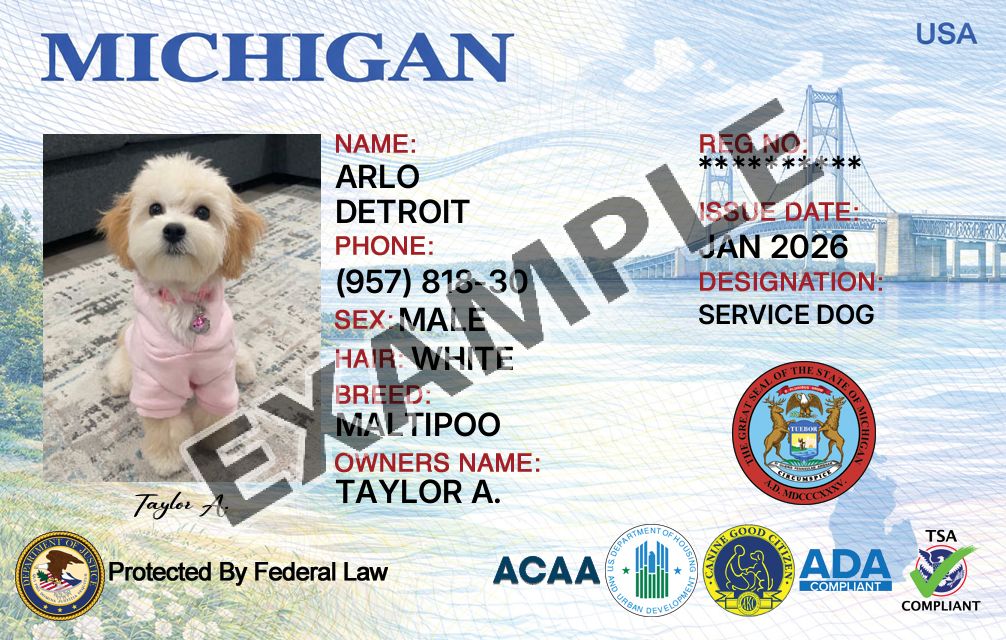
Registering a Dog in Mason County, Michigan (Including Service Dogs & Emotional Support Dogs)
If you’re asking where do I register my dog in Mason County, Michigan for my service dog or emotional support dog, the key thing to know is that “registration” usually means getting a dog license in Mason County, Michigan. A dog license is a local government requirement tied to rabies vaccination and identification—while a service dog’s legal status (and an emotional support animal’s rules) are handled under different laws and do not come from a “service dog registry.” This page explains where to register a dog in Mason County, Michigan, what paperwork you’ll typically need, and how licensing differs from service dog and ESA rules.
Where to Register or License Your Dog in Mason County, Michigan
Because licensing is often managed at the county (and sometimes city/township) level, the most common places to get an animal control dog license Mason County, Michigan residents need are the county animal control office and the county treasurer’s office. Below are example official offices within Mason County, Michigan that are directly connected to dog licensing and enforcement.
Primary County Office (Licensing & Enforcement)
| Office | Details |
|---|---|
Mason County Animal Control |
Address: 305 N Meyers Rd
City/State/ZIP: Ludington, MI 49431
Phone: (231) 843-8644
Email: animalcontrol@masoncounty.net
Office hours:
Mon, Tue, Fri, Sat 9:00 AM–12:00 PM; Wed, Thu 3:00 PM–6:00 PM
|
This is typically the best first call if you’re unsure where to register a dog in Mason County, Michigan or if you have questions about enforcement, rabies documentation, or renewal timing.
County Courthouse Office (License Sales)
| Office | Details |
|---|---|
Mason County Treasurer |
Address: Mason County Courthouse, 304 E. Ludington Avenue, Suite 104
City/State/ZIP: Ludington, MI 49431-2121
Office hours: Monday–Friday 8:00 AM–5:00 PM
Email: Not listed on the office contact section (use the county’s general email form or call).
|
The Treasurer’s Office oversees the sale of dog licenses under Michigan’s dog law, while enforcement is handled by the county animal control officer.
Overview of Dog Licensing in Mason County, Michigan
What “registering” your dog usually means
In everyday language, people say “register my dog,” especially when they have a service dog or emotional support dog. In Mason County, “registration” typically means purchasing and maintaining a current county dog license tag. This is a local identification system that helps: reunite lost dogs with owners, support animal control services, and confirm compliance with public health requirements like rabies vaccination.
Rabies vaccination requirement (why it matters for licensing)
Michigan requires dogs to be currently vaccinated against rabies, and Mason County requires proof of current rabies vaccination to obtain a dog license. In practice, you should expect to show a rabies certificate from your veterinarian when you apply or renew. If your rabies due month passes and you have not renewed your license, the county may charge a delinquent rate.
License length and renewal timing
Mason County offers 1-year and 3-year dog licenses. The ability to purchase a 3-year license is tied to receiving a 3-year rabies booster and having the matching time remaining until the next rabies dose is due. Licenses expire in the month the rabies vaccination is due, so many residents plan renewals around veterinary visits.
A rabies tag is not a county dog license tag
Your veterinarian may provide a rabies vaccination tag, but Mason County specifically notes that the rabies vaccination tag is not the same as a dog license. To be compliant, you typically need both: current rabies vaccination and a current Mason County dog license tag.
How Dog Licensing Works Locally in Mason County, Michigan
Step-by-step: where and how to buy a license
- Confirm your dog needs a license: Mason County requires dogs 4 months and older that reside within the county to wear a county dog license.
- Gather proof of rabies vaccination: Bring or submit documentation showing your dog is currently vaccinated against rabies.
- Bring spay/neuter documentation if applicable: Mason County uses a discounted license fee for spayed/neutered dogs when you provide the record.
- Purchase in-person: Licenses can be purchased through Mason County Animal Control or through the Mason County Treasurer’s office at the courthouse in Ludington.
- Keep the license current and the tag on your dog: Tags help animal control quickly identify ownership, especially if your dog is found at large.
Why licensing is handled locally (and why it can feel confusing)
People often search for “state registration” for service dogs or ESAs. But dog licensing is a local government function in Michigan: counties (and sometimes local municipalities) handle licensing and enforcement. That’s why the answer to where to register a dog in Mason County, Michigan is usually a county office, not a national registry or a private website.
Fees, delinquent renewals, and year-round availability
Mason County licenses are available year-round, but delinquent rates can apply if you renew late (for example, after the rabies due month or if the license wasn’t current during the prior year). If you’re on a tight deadline—moving, new dog, or updating your paperwork for housing—call the county office and ask what they need for same-day issuance.
If your dog is a service dog or emotional support dog
Your dog’s role as a service dog or emotional support animal does not replace the need for local licensing. In other words, a service dog can still need a standard dog license in Mason County, Michigan like any other dog. The “service dog” part is about disability access rights and training; the “dog license” part is about local identification and rabies compliance.
Service Dog Laws in Mason County, Michigan
What makes a dog a service dog (and what doesn’t)
A service dog is generally a dog that is individually trained to do work or perform tasks for a person with a disability. Service dog access rights mainly come from federal disability law (such as the ADA for public places). A county dog license is not what creates service dog status—so you should be cautious of any “registration” that claims to certify a service animal through a card or online listing.
Questions a business may ask (public access basics)
In places of public accommodation, if it’s not obvious what service your dog provides, staff are generally limited to asking two questions: (1) whether the dog is required because of a disability and (2) what work or task the dog has been trained to perform. They generally cannot require documentation, demand an ID card, or ask for details about your disability.
Local licensing still applies to service dogs
Even though service dog rules are about disability access, local public health and animal control rules still matter. That’s why the practical answer to where do I register my dog in Mason County, Michigan for my service dog or emotional support dog usually has two parts: (1) get your local license tag through the county and (2) understand service dog access rules for public spaces.
Emotional Support Animal Rules in Mason County, Michigan
ESA vs. service dog: the most common mix-up
An emotional support animal (ESA) provides comfort by its presence, but ESAs are not the same as service animals under public access rules. Many people look for “ESA registration,” but the most important part is typically documentation from a qualified health professional for the setting where it’s relevant (most often housing). An ESA label does not automatically grant the same public access rights as a service dog.
Licensing and rabies rules still apply to ESAs
Whether your dog is a pet, an ESA, or a service dog, Mason County licensing is still a separate local requirement. To stay compliant, you still need the basics for a county license: proof of current rabies vaccination and (if you want a discounted rate) proof of spay/neuter. For most residents, the “registration” step is simply purchasing the county dog license tag and renewing it on time.
Where ESAs matter most (practical planning)
ESAs most often come up in housing contexts. If you are preparing paperwork for a landlord or housing provider, you may need two separate sets of documents: (1) county licensing/rabies documentation for animal control compliance and (2) any ESA documentation needed for housing accommodation requests. If you’re unsure what your housing provider can request, consider contacting a qualified advocate or legal resource—but keep your county license current regardless.
Frequently Asked Questions
Yes, in most cases. Service dog status is about disability-related training and access rights, while a dog license in Mason County, Michigan is a local animal control and public health requirement tied to rabies vaccination and identification. Keep your license current even if your dog is a working service animal.
Start with Mason County Animal Control in Ludington, which handles licensing information and enforcement. Licenses may also be purchased through the Mason County Treasurer’s office at the courthouse. If you’re not sure which is faster for your situation, call ahead and ask what documentation they need and whether you can get the tag the same day.
No. A rabies vaccination tag shows your dog was vaccinated; a county dog license tag shows you purchased the local license. Mason County emphasizes that the rabies tag is not a dog license. You typically need proof of rabies vaccination to obtain the license.
If you need an answer today, contact Mason County Animal Control or the Mason County Treasurer’s office (courthouse in Ludington). Have your rabies certificate ready, and bring spay/neuter documentation if applicable. That’s the fastest path for most new residents asking where to register a dog in Mason County, Michigan.
For county purposes, your ESA is generally licensed the same way as any other dog (rabies proof + local license tag). “ESA registration” is not typically a county licensing category. If you’re dealing with housing, ESA documentation is usually handled separately from licensing, while the county license remains a standard requirement.